
Guide series
Student Life
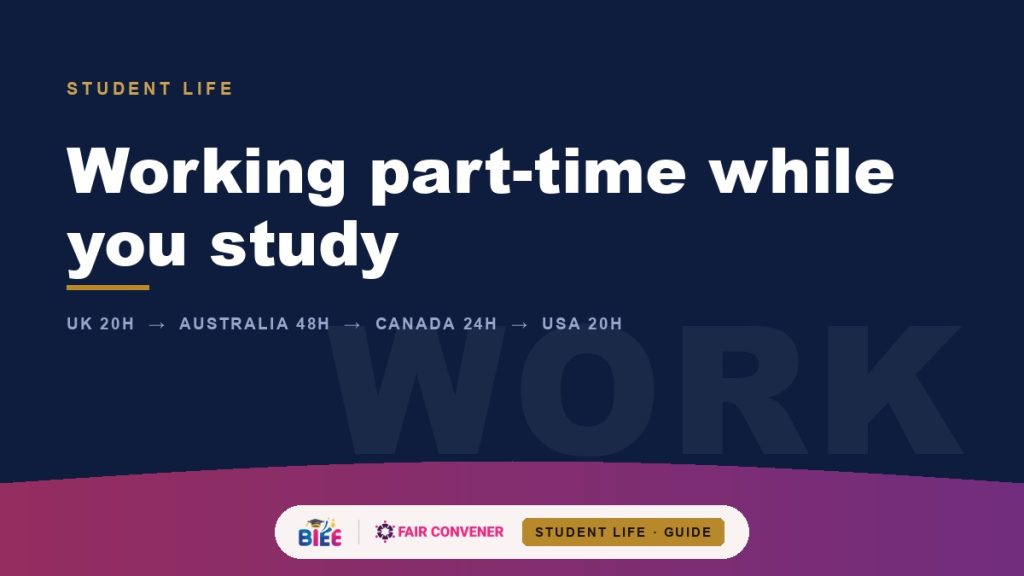
Working part-time while you study: the real rules, country by country
How many hours you may legally work in the UK, Australia, Canada and the USA — and why breaking the limit costs more than the money you earn.
Every family that sends a child abroad has this conversation, usually at the dining table, usually with a phone calculator. Somebody finds an hourly wage online, multiplies it by a full working week, converts to taka, and announces that the tuition problem has solved itself.
It has not. Part-time work pays for groceries, transport and a phone bill. It does not pay for a degree, and every visa system in this article assumes you arrived with your funding already arranged.
Treat the numbers below as legal limits, not as an income plan. Student work rules are visa conditions in all four countries, so the rest of this guide reads more like immigration law than careers advice.
How many hours can I work as a student in the UK, Australia, Canada and the USA?
| Destination | During term / while classes are in session | Outside term / breaks |
|---|---|---|
| UK (Student visa) | 20 hours per week at degree level or above; 10 hours per week below degree level | Full time |
| Australia (subclass 500) | 48 hours per fortnight | No limit when the course is not in session |
| Canada (study permit) | 24 hours per week off campus | Unlimited during scheduled breaks |
| USA (F-1) | 20 hours per week on campus | May exceed 20 hours during breaks and annual vacation |
Four countries, four different clocks. One counts weeks, one counts fortnights, one distinguishes degree level from below degree level, and one restricts you to your own campus. No country’s rule transfers to another’s. The senior in your WhatsApp group who studied somewhere else is a bad source.
United Kingdom: 20 hours, and what a “week” means
UKCISA sets out the distinction most students miss. The cap is 20 hours a week in term time if you are studying at degree level or above, but only 10 hours a week below degree level. So a foundation year, a diploma or a pre-sessional programme can carry half the working rights of the degree that follows it, on the same visa, in the same city.
A “week” means any seven-day period starting on a Monday. That definition does real work: it stops you stacking a heavy Sunday onto a heavy Monday and calling them two different weeks.
Two details catch people out:
- The limit is on total hours, not per employer. Two jobs at 15 hours each is a breach, not a workaround.
- You are responsible for tracking it. Keep your own records, especially with irregular shifts.
You can work full time outside term time: vacations, before your course starts, on placements, and after the course ends. Your university may also impose its own stricter recommendation, so check what your department expects before you accept a rota. Read this alongside the UK route guide for Bangladeshi applicants, because the maintenance funds you show at visa stage and the hours you may work afterwards are two halves of the same argument.
Australia: 48 hours a fortnight, and who is exempt
The Department of Home Affairs sets the Student visa work limit at a maximum of 48 hours per fortnight. The fortnight matters. You cannot borrow from next fortnight because a restaurant is short-staffed this one.
That limit applies during study terms and semesters, including exam periods, before your course starts, and while you are doing another course that counts towards your main course. Exam weeks are the classic trap. Students assume that because there are no lectures, the course is not in session.
Two exemptions matter:
- There is no work-hour limit when your course is not in session.
- Students who have commenced a masters by research or a doctoral degree have no work-hour limit either — an exemption badly under-advertised in Dhaka.
If you are weighing a coursework masters against a research masters in Australia, put the work rights into the comparison rather than the footnotes. The Australia guide has the rest of the detail.
Canada: 24 hours a week, if your programme qualifies
IRCC allows eligible students to work up to 24 hours per week off campus while classes are in session, raised from the previous 20-hour limit, and unlimited hours during scheduled breaks such as summer and winter holidays or a reading week.
Read the word “eligible” carefully, because this is the country where students most often discover they have no work rights at all. You must be a full-time student at a designated learning institution, and your programme must be at least six months long and lead to a degree, diploma or certificate. A short language course or a programme that does not meet that bar gives you no off-campus work rights whatsoever.
The agent selling you an admission in Banani will not raise this on his own. Ask it directly and keep the answer on paper: does this specific programme, at this specific institution, qualify me for off-campus work? Then verify it yourself against the Canada study permit requirements.
United States: on campus first, everything else needs paperwork
The USA is the most restrictive of the four for ordinary part-time work. F-1 students may work up to 20 hours per week on campus while school is in session, and may exceed that during breaks and annual vacation.
- Total hours across all on-campus jobs must stay within 20 during the term.
- Off-campus work requires separate authorisation, CPT for curriculum-related work or OPT during or after your programme, arranged through your DSO.
- You can apply for on-campus employment up to 30 days before classes start, through your DSO.
Campus jobs are finite and the good ones go early. Use that 30-day window. By week three, once the cost of the city has sunk in and everyone else has had the same idea, the library jobs are taken. The USA route guide covers the I-20 and the DSO relationship that all of this hangs off.
DHS is blunt about the consequence of getting this wrong: not complying with on-campus employment guidelines “may be a violation of status that could result in the F-1 student having to leave the United States.”
What an extra shift costs when it goes wrong. In every one of these systems, exceeding work hours is an immigration breach, not a workplace one. Realistic outcomes include visa cancellation, removal, and a re-entry ban that follows you for years, against an extra few hours of minimum-wage pay. Students also lose status because an employer paid them cash “off the books”; the employer faces a fine, you face your visa.
The asymmetry nobody explains before you fly
Understand who carries the risk in a cash job. The restaurant owner who offers to pay you off the books is risking a fine and an afternoon with an inspector. You are risking the visa, the degree, the money your family has already spent, and your ability to return to that country for years.
Those are not comparable losses, and the person offering you the shift knows it. He will also be entirely unavailable when the consequences arrive.
The paperwork to sort out before your first shift
- Confirm your visa condition in writing. Read your own grant letter or visa conditions. Not a friend’s summary, not a Facebook comment, not what your bhaiya remembers from his own intake.
- Get the local number you need to work legally: a National Insurance number in the UK, a TFN in Australia, a SIN in Canada, an SSN in the USA via your DSO’s certification letter.
- Understand what counts as “in session” at your institution. Exam periods usually count as term time.
- Keep a personal hours log across all employers.
- Know your rights as a worker. Being an international student does not reduce your entitlement to the legal minimum wage.
Wages are where this bites hardest. Employers abroad routinely pay Bangladeshi students below the legal minimum on the assumption that they will not complain. A student visa caps how many hours you may work; it does not make you cheaper than the person standing next to you.
Can a part-time job pay your tuition?
No, and it is better to hear that in Dhaka than to discover it in November.
At 20 hours a week on a local minimum wage, part-time work in any of these countries covers living expenses at best. Every visa system already assumes this. The UK requires proof of maintenance funds, Australia requires evidence of financial capacity, and Canada requires proof of financial support. None of them accept “I will work and earn it there” as a funding plan, and visa officers reject applications built on that assumption.
This is also the single most common thing an under-regulated agent will imply without quite saying. If somebody in a Dhanmondi or Uttara office suggests that a student “easily manages” fees from part-time work, they are describing a visa refusal, not an opportunity. Cross-check the arithmetic against the real first-year cost of studying abroad and against what you have budgeted for accommodation and deposits, and you will see how far a capped weekly wage goes.
Frequently asked questions
How many hours can I work as a student in the UK, Australia and Canada?
In the UK, 20 hours per week in term time at degree level or above, and 10 hours per week below degree level. In Australia, a maximum of 48 hours per fortnight on a subclass 500 visa. In Canada, up to 24 hours per week off campus while classes are in session. Outside term, the UK allows full-time work, Australia removes the limit when the course is not in session, and Canada allows unlimited hours during scheduled breaks.
Does the limit apply per job or across all my jobs?
Across all of them. UKCISA is explicit that the cap is on total hours, not per employer, so two jobs at 15 hours each is a breach rather than a clever workaround. The same total-hours principle applies to on-campus work in the USA, where all on-campus jobs together must stay within 20 hours during the term.
Can I work full time during semester breaks and holidays?
In the UK you can work full time outside term time, including vacations, before your course starts, on placements and after the course ends. Australia has no work-hour limit when your course is not in session. Canada allows unlimited hours during scheduled breaks such as summer and winter holidays or a reading week. In the USA, F-1 students may exceed 20 hours during breaks and annual vacation.
Do exam weeks count as term time?
Usually yes. Australia’s limit explicitly applies during study terms and semesters including exam periods. Confirm what “in session” means at your own institution before you accept extra shifts during an exam block, because no lectures on the timetable does not mean the course has stopped.
What happens if I work more hours than my visa allows?
You have committed an immigration breach, not a workplace one. Realistic outcomes include visa cancellation, removal and a re-entry ban lasting years. DHS warns that failing to comply with on-campus employment guidelines may be a violation of status that could result in an F-1 student having to leave the United States. The money earned in those extra hours is never worth what it puts at risk.
Do I need a National Insurance number, TFN, SIN or SSN before starting a job?
Yes, get the local number for your country: a National Insurance number in the UK, a TFN in Australia, a SIN in Canada, and an SSN in the USA obtained through your DSO’s certification letter. Sort this out early. It is administrative, it takes time, and no legitimate employer can put you on a payroll without it.
Can I work off campus on an F-1 visa in the USA?
Not without separate authorisation. On-campus work is capped at 20 hours per week while school is in session. Off-campus work requires CPT for curriculum-related employment or OPT during or after your programme, and both are arranged through your DSO. You can apply for on-campus employment up to 30 days before classes start.
Can I pay my tuition from a part-time job?
No. At 20 hours a week on a local minimum wage, part-time work covers living expenses at best. The UK requires proof of maintenance funds, Australia requires evidence of financial capacity and Canada requires proof of financial support, precisely because none of these systems accept earning it there as a funding plan. Applications built on that assumption get refused.
Sources
- UKCISA — Working as an international student (20 hours degree level, 10 hours below degree, Monday-start week, total-hours rule)
- GOV.UK — Student visa
- Department of Home Affairs, Australia — Student visa (subclass 500) and visa conditions (48 hours per fortnight; research/doctoral exemption)
- IRCC, Government of Canada — Work off campus as an international student (24 hours per week; unlimited during scheduled breaks; eligibility conditions)
- U.S. Immigration and Customs Enforcement (ICE) / Study in the States, DHS — Employment and Working in the United States (20 hours on campus; DSO authorisation; status-violation warning)
Rules were checked against these official sources in August 2026. Work-hour limits have changed more than once in recent years in every one of these countries — confirm the current condition on the official site before relying on it.
Ask about work rights at the source
65th Bangladesh International Education Expo · 26–28 November 2026 · ICCB, Dhaka. Free entry and free counselling.
International Convention City Bashundhara (ICCB), Bashundhara, Dhaka, Bangladesh · Free entry
Email info@bangladeshinternationaleducationexpo.com
Web bangladeshinternationaleducationexpo.com